
by Eric Henon, President, EACH Enterprise
Summary
This article provides guidance for administrators of 401(k), 403(b), and 457 retirement plans on participant requests to reverse a cash distribution of plan assets in good order, even if the participant misunderstood the tax implications. The article outlines the legal, financial, operational, and fiduciary risks involved, and emphasizes the importance of maintaining plan integrity and compliance.
 How the Story Starts
On a rare occasion, a plan participant may approach the service provider of their 401(k), 403(b), or 457 retirement plan after requesting a cash distribution of plan assets with all required documentation, asking that the good order transaction be reversed, arguing that they did not realize that income tax would be due and withheld at the time of distribution. However, a plan sponsor would be ill-advised to authorize such a request that would expose them to fiduciary risk.
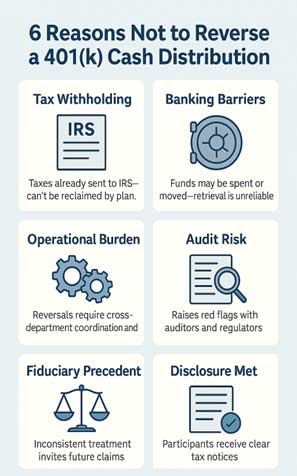
Tax Withholding Is Irrevocable
Once a distribution is processed, federal income taxes are withheld and sent to the IRS immediately. These funds are no longer under the plan’s control. Reversing the transaction would require a reimbursement from the IRS—something neither the plan sponsor nor the service provider is authorized or equipped to request. Participants must resolve any tax overpayment through their personal tax return.
Custodial and Banking Barriers
After distribution, funds are typically deposited into a participant’s personal account. They may be spent, moved, or invested. Even if a participant agrees to return the money, retrieving and reprocessing it is complex and unreliable. This introduces unnecessary risk to the plan and its fiduciaries.
Operational Complexity and Cost
Reversals are not simple. They require recalculating taxes, issuing corrected tax forms (e.g., 1099-R), updating plan records, and coordinating across multiple departments. These tasks are time-consuming and costly, diverting resources from core operations and potentially increasing fees for all participants.
Audit and Regulatory Risk
Reversing a distribution can raise red flags during audits by the Department of Labor (DOL) or independent auditors. It may be viewed as a prohibited transaction or operational failure, exposing the plan to penalties and reputational damage.
Fiduciary Risk and Precedent
Making exceptions based on participant misunderstandings sets a dangerous precedent. It opens the door to future claims and undermines the consistent application of plan rules. Fiduciaries must act in the best interest of all participants—not just one.
Disclosure Obligations Are Met
Participants receive clear documentation about tax implications, including Summary Plan Descriptions, distribution forms, and IRS Form 402(f) Special Tax Notice. The plan’s responsibility is to provide this information—not to ensure it is read or understood.
Conclusion
While participant confusion is unfortunate, reversing a legally executed distribution in good order is not the answer. The risks far outweigh the benefits. Upholding the integrity of plan operations protects everyone—sponsors, fiduciaries, and participants alike.
Write to Eric Henon at